Microsoft Unveils MAI Code 2, Work IQ, and Agent 365 at Ignite 2026 as OpenAI Ships 1.05M-Context GPT-6.2 Astra and Sol
Enterprise AI orchestration and agentic coding shifted gears simultaneously at Microsoft Ignite 2026 as Microsoft debuted in-house MAI Code 2 models, Work IQ context graphs, and Agent 365 telemetry alongside OpenAI’s lower-cost GPT-6.2 Astra and GPT-6.2 Sol rollout across ChatGPT Work, Codex, GitHub Copilot, and Vercel AI Gateway.
At a Glance
- What changed: At Ignite 2026 in San Francisco, Microsoft introduced proprietary MAI Code 2 and MAI Code 2 Flash coding models in GitHub Copilot and Microsoft Foundry alongside Microsoft IQ (Work IQ, Fabric IQ, Foundry IQ, Web IQ), Copilot Autopilot agents, Agent 365 audit streaming, Azure DevOps and Browser Use previews in the Copilot app, and GitHub Copilot Evals—while OpenAI simultaneously launched 1.05M-context GPT-6.2 Astra and GPT-6.2 Sol across ChatGPT Work, Codex, the API, GitHub Copilot, and Vercel AI Gateway.
- Who can use it: MAI Code 2 Flash reaches all GitHub Copilot tiers including Free and Student, while MAI Code 2 is live on Copilot Pro, Pro+, Max, Business, and Enterprise (including annual plans); GPT-6.2 Astra and Sol are generally available on Copilot Pro+, Max, Business, and Enterprise as well as ChatGPT Work, Codex, OpenAI’s API, and Vercel AI Gateway; and Agent 365 Copilot streaming is open to GitHub Enterprise Cloud organizations with Enterprise Managed Users.
- What it costs: OpenAI cut GPT-6.2 Astra standard API rates by 20% to $8.00/M input and $40.00/M output tokens ($0.40/M cached input, $10.00/M cache writes, plus a 60% cheaper Ultrafast output tier vs. GPT-6 Astra) while keeping GPT-6.2 Sol at $2.00/M input and $10.00/M output ($0.10/M cached input); inside GitHub Copilot, both GPT-6.2 and MAI Code 2 families bill under usage-based plan allowances.
- Why should I care: Engineering and IT leaders no longer have to pay flagship frontier token prices for every repository edit or run ungoverned shadow agents—Microsoft is driving down routine coding unit economics with first-party MAI Code 2 models and centralized Agent 365 / Entra Agent ID controls just as OpenAI slashes 1M-context agentic review and Ultrafast execution costs.
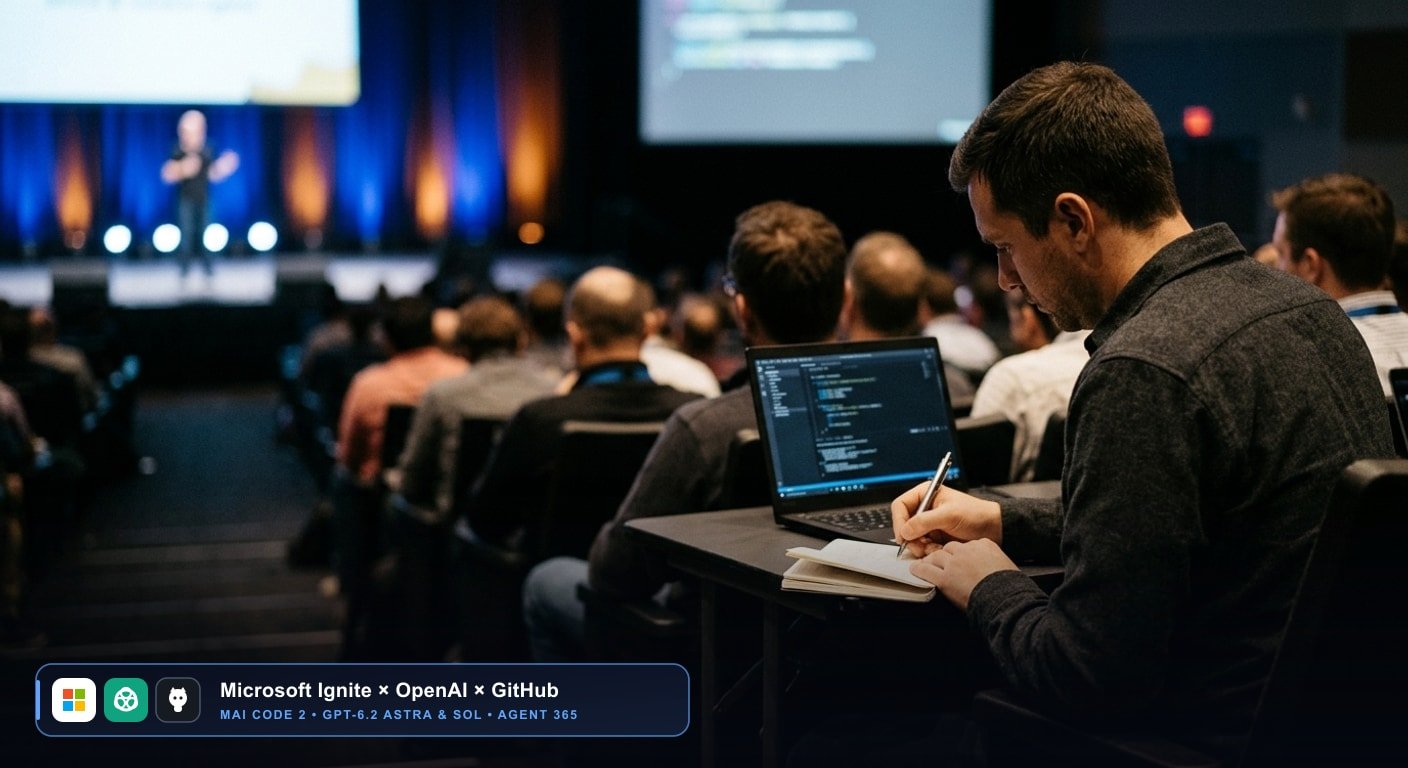
Enterprise buyers evaluating agentic software platforms got a rare dual release on November 17, 2026. Taking the opening keynote stage at Ignite 2026 in San Francisco, Microsoft CEO Satya Nadella unveiled an integrated enterprise agent stack anchored by proprietary MAI Code 2 and MAI Code 2 Flash coding models, the Work IQ organizational context database, and the Microsoft Agent 365 observability control plane. Within the exact same afternoon window, OpenAI shipped GPT-6.2 Astra and GPT-6.2 Sol across ChatGPT Work, Codex, the OpenAI API, GitHub Copilot, and Vercel AI Gateway—expanding context capacity to 1.05 million tokens while trimming flagship token and Ultrafast inference prices.
Microsoft Ignite 2026: MAI Code 2 Economics, Work IQ Context & Agent 365 Governance
Framing Microsoft Copilot as a unified operating system spanning Chat, Cowork, Code, and 24×7 Autopilot agents, Microsoft moved decisively at Ignite 2026 to differentiate its first-party model economics and enterprise governance from generic frontier APIs (SaaS Plan Changes):
- MAI Code 2 & MAI Code 2 Flash in GitHub Copilot: Built by Microsoft AI (MAI) with native vision support and repository-wide reasoning, MAI Code 2 targets multi-file refactoring, deep debugging, and end-to-end feature implementation across Copilot Pro, Pro+, Max, Business, and Enterprise (including annual plans)—delivering roughly 98% of GPT-6.1 Sol’s coding performance at 40% of the cost and 96% of Claude Opus 5.5’s performance at 5% of the cost in Microsoft’s internal benchmarks. Its companion, MAI Code 2 Flash, extends high-speed agentic edits and explanations all the way to Copilot Free and Student users alongside paid tiers across VS Code, Visual Studio, Copilot CLI, JetBrains, Xcode, Eclipse, mobile, and
github.com. - Work IQ & Role-Specific Copilot Skills: Part of the broader Microsoft IQ family (alongside Fabric IQ, Foundry IQ, and Web IQ), Work IQ maps institutional relationships across emails, chats, meetings, documents, and projects while packaging curated connectors and plugins for sales, legal, finance, and service teams—matching OpenAI’s parallel November 17 debut of ChatGPT for Sales with 30+ CRM and pitch plugins.
- Agent 365 Audit Streaming & Entra Agent ID: For GitHub Enterprise Cloud customers using Enterprise Managed Users, administrators can now stream prompt, response, and tool-call telemetry from every Copilot surface directly into Microsoft Agent 365, linking coding agents with Microsoft Purview, Microsoft Defender, Agent 365 Business Analytics ROI tracking, and cross-cloud Microsoft Entra Agent ID governance.
Model Specs, API Token Pricing & Plan Eligibility Across November 17’s Releases
The table below compares pricing, context limits, benchmark positioning, and enterprise plan availability across OpenAI’s GPT-6.2 family and Microsoft’s Ignite 2026 Copilot announcements (Model Pricing & Inference):
| Release / Platform | Core Architecture & Capabilities | Pricing & Speed-Tier Structure | Plan & Surface Availability |
|---|---|---|---|
OpenAI GPT-6.2 Astra (openai/gpt-6.2-astra) |
1.05M context window; flagship multi-step codebase changes, terminal execution, computer use & strict template adherence | $8.00/M input (-20%), $40.00/M output, $0.40/M cached read, $10.00/M cache write; Ultrafast output 60% cheaper vs. GPT-6 Astra | ChatGPT Work, Codex, OpenAI API, Vercel AI Gateway & GitHub Copilot (Pro+, Max, Business, Enterprise) |
OpenAI GPT-6.2 Sol (openai/gpt-6.2-sol) |
1.05M context window; catches ~2× more real code-review defects than GPT-6.1 Sol using fewer tokens; interactive web builds | $2.00/M input, $10.00/M output, $0.10/M cached read, $2.50/M cache write (2× input / 1.5× output past 272K tokens) | ChatGPT Work, Codex, OpenAI API, Vercel AI Gateway & GitHub Copilot (Pro+, Max, Business, Enterprise) |
| Microsoft MAI Code 2 & MAI Code 2 Flash | First-party Microsoft AI agentic coding models with vision support; ~98% of GPT-6.1 Sol quality at 40% cost (MAI Code 2) | Usage-based GitHub Copilot & Microsoft Foundry billing optimized for high-frequency loops | MAI Code 2: Pro, Pro+, Max, Business, Enterprise; MAI Code 2 Flash adds Copilot Free & Student |
| Copilot App Ignite Suite, Evals & Agent 365 | Azure DevOps PR/agent-merge preview; isolated Chromium Browser Use preview; Vally-powered /eval; Agent 365 Purview/Defender stream |
Included in qualifying Copilot & Microsoft 365 / Entra governance subscriptions | Copilot Evals on Individual, Business & Enterprise; Agent 365 streaming on GHEC with Enterprise Managed Users |
OpenAI’s GPT-6.2 Astra & Sol: 1.05M Context, Ultrafast Cuts & System Card Guardrails
On the model frontier, OpenAI engineered GPT-6.2 Astra and GPT-6.2 Sol specifically around lower cost-per-completed-task rather than raw benchmark inflation alone. Both models feature a 1.05-million-token context window (requests exceeding 272K input tokens trigger a 2× input/cache multiplier and 1.5× output multiplier across the full call) alongside flexible latency tiers: Batch API (50% off standard rates), asynchronous Background requests (30% off for a 2-hour window; 40% off for an 8-hour window), Fast mode (2×), and Ultrafast mode (service_tier: 'ultrafast' at 3× standard rates through February 28, 2027—bringing Astra’s Ultrafast output token price down 60% below GPT-6 Astra). Developers on Vercel AI Gateway can route to openai/gpt-6.2-astra or openai/gpt-6.2-sol immediately via the AI SDK, Responses API, or npx vercel ai-gateway setup.
In GitHub’s pre-release Copilot evaluations, GPT-6.2 Sol flagged nearly twice as many genuine code-review bugs as GPT-6.1 Sol while consuming fewer tokens, whereas GPT-6.2 Astra excelled at complex multi-file diffs, terminal workflows, and computer use. Notably, OpenAI’s accompanying System Card discloses that both models crossed high cybersecurity thresholds for vulnerability-to-exploit synthesis—and that GPT-6.2 Astra is OpenAI’s first externally deployed model to hit the “High” capability threshold for AI Self-Improvement, prompting stricter default runtime guardrails and continuous Control Room monitoring.
GitHub Ships Azure DevOps Repos, Isolated Browser Use & Vally-Powered Copilot Evals
To help engineering teams put those competing models to work safely across heterogeneous toolchains (Cloud & Developer Infrastructure), GitHub rounded out its Ignite wave with three practical workflow upgrades. First, the GitHub Copilot app added public preview support for Azure DevOps repositories—letting developers clone repos, delegate branch creation and code fixes to an agent, and enable agent merge once Azure DevOps CI checks and branch policies pass (alongside GA support for GitHub Enterprise Server on app v1.2.0+, though cloud sessions remain unavailable for both). Second, off-by-default Browser Use entered public preview across Google Chrome and Microsoft Edge via the Copilot Chrome extension, running inside an isolated tab group alongside Computer Use in the Copilot app, CLI, VS Code, and JetBrains.
Finally, GitHub Copilot Evals launched in public preview across VS Code, Copilot CLI, and the Copilot app (via the github/evals marketplace) for Individual, Business, and Enterprise plans. Powered by the extensible local Vally evaluation engine and invoked via natural language or /eval, Evals lets teams run human-approved, repeatable regression checks whenever they swap between MAI Code 2, GPT-6.2 Sol, or custom MCP tools and skills—turning model selection from guesswork into measurable engineering telemetry.
Why It Matters
November 17 crystallized a structural realignment between Microsoft, GitHub, and OpenAI inside the enterprise software stack. Even as GitHub Copilot and Vercel AI Gateway roll out OpenAI’s newest frontier GPT-6.2 Astra and Sol models on day one, Microsoft is aggressively insulating its own margins—and enterprise customers’ usage budgets—by shipping proprietary MAI Code 2 and MAI Code 2 Flash models engineered to capture routine and multi-file software tasks at a fraction of frontier inference cost. At the same time, Microsoft IQ (anchored by Work IQ) and Agent 365 establish an identity, context, and ROI control plane spanning not only Microsoft and GitHub agents, but external workloads running across OpenAI, Anthropic, AWS Bedrock, and Google.
What Is Confirmed
Confirmed across six primary disclosures published November 17, 2026 by Microsoft, OpenAI, GitHub, and Vercel: (1) Microsoft CEO Satya Nadella’s Ignite 2026 keynote introduced Copilot Chat/Cowork/Code/Autopilot workspaces grounded in Work IQ (alongside Fabric IQ, Foundry IQ, and Web IQ) and governed via Microsoft Agent 365 and Entra Agent ID; (2) MAI Code 2 (Pro, Pro+, Max, Business, Enterprise) and MAI Code 2 Flash (adding Free and Student) are live across VS Code, Visual Studio, Copilot CLI, JetBrains, Xcode, Eclipse, mobile, and github.com; (3) OpenAI’s GPT-6.2 Astra ($8/M input, $40/M output, $0.40/M cached) and GPT-6.2 Sol ($2/M input, $10/M output, $0.10/M cached) support up to 1.05M context tokens (with 2x input/cache and 1.5x output multipliers past 272K input tokens), Batch (50% off), Background windows (30%–40% off), Fast (2x), and Ultrafast (3x through Feb 28, 2027), and are GA in GitHub Copilot (Pro+, Max, Business, Enterprise) and Vercel AI Gateway; and (4) GitHub shipped Agent 365 audit-log streaming for Enterprise Managed Users, Vally-powered GitHub Copilot Evals (/eval) in public preview, and Copilot app previews for Azure DevOps repositories and isolated Chromium Browser Use alongside GA GitHub Enterprise Server v1.2.0+ support.
What Remains Unclear
Microsoft has not yet published standalone per-million-token Foundry API list rates for MAI Code 2 and MAI Code 2 Flash outside GitHub Copilot usage-based billing, Azure DevOps and GHES integrations in the GitHub Copilot app do not yet support cloud agent sessions, and OpenAI’s Ultrafast 3x promotional multiplier is currently slated through February 28, 2027 while GPT-6.2 Astra operates under heightened System Card guardrails after crossing OpenAI’s High threshold for AI Self-Improvement.
Sources & Underlying Evidence (6)
We link directly to the primary documents supporting our reporting and distinguish company claims from independently checked facts.
- Ignite 2026: Building the frontier ecosystemPublisher: Microsoft Official Blog • Type: Official AnnouncementSource date: Nov 17, 2026
- Introducing GPT-6.2 Astra and SolPublisher: OpenAI • Type: Official AnnouncementSource date: Nov 17, 2026
- MAI Code 2 and MAI Code 2 Flash in GitHub CopilotPublisher: GitHub Changelog • Type: Product ChangelogSource date: Nov 17, 2026
- OpenAI’s GPT-6.2 Astra and GPT-6.2 Sol now available in GitHub CopilotPublisher: GitHub Changelog • Type: Product ChangelogSource date: Nov 17, 2026
- GitHub Copilot app, Microsoft Ignite releases & Monitor Copilot activity through Microsoft Agent 365Publisher: GitHub Changelog • Type: Product ChangelogSource date: Nov 17, 2026
- GPT-6.2 Astra and Sol now available on Vercel AI GatewayPublisher: Vercel Changelog • Type: Product ChangelogSource date: Nov 17, 2026